
In an era of rising food costs, many households are removing luxury items like high-end steak from their shopping lists. However, a growing trend in “home butchery” is revealing that you don’t have to sacrifice quality to stay on budget. By shifting from buying pre-cut steaks to “whole primal” cuts, savvy consumers are accessing premium beef for a fraction of the retail price.
Understanding the Grades: Choice vs. Prime
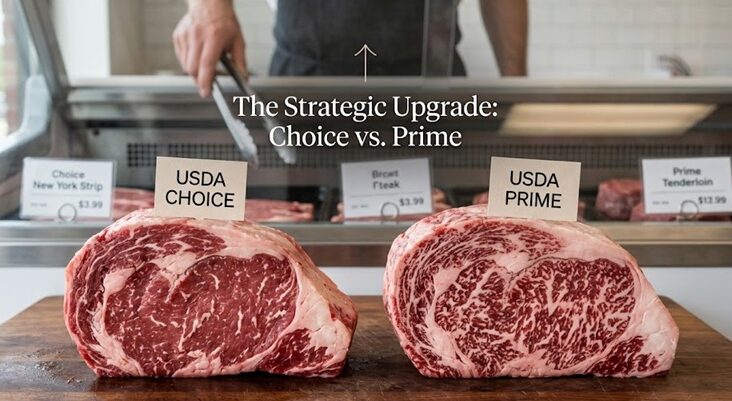
To maximize value, it is essential to understand what you are paying for at the meat counter. Beef is generally categorized into three tiers based on marbling (the white flecks of intramuscular fat that provide flavor and tenderness):
-
Select: The leanest grade, often used for mass-market catering.
-
Choice: High-quality beef with moderate marbling; this is the standard found in most grocery stores.
-
Prime: The top tier of beef, representing only a small percentage of all production. It features the highest degree of marbling and is usually reserved for high-end steakhouses.
The Strategy: Occasionally, the price gap between “Choice” and “Prime” narrows significantly. When the difference is only a few dollars per pound, the upgrade to Prime offers significantly more value in flavor and texture for a marginal increase in cost.
The “Whole Primal” Advantage
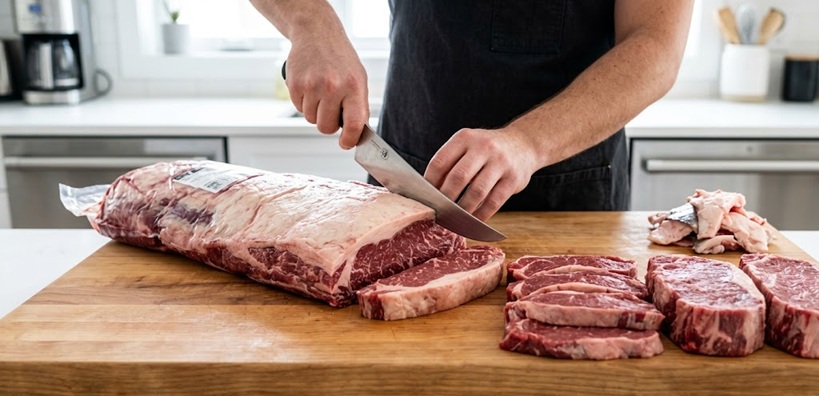
The secret to saving hundreds of dollars is purchasing the whole primal loin—the large, vacuum-sealed sub-primal cut—rather than individual steaks.
When meat is pre-cut and packaged by the store, you are paying a “convenience tax” for the labor of the butcher. By taking that labor into your own kitchen, you can capture those savings for yourself.
How to Process a Whole Loin at Home
Processing a whole New York strip or ribeye loin is simpler than most realize. You only need a large cutting board and a sharp knife (ideally a 10-inch breaking knife with a curved blade).
-
Custom Thickness: Unlike pre-packaged steaks, cutting your own allows you to choose the exact thickness. Whether you prefer a standard 1-inch cut or a thick, 2-inch “steakhouse” style, you have total control.
-
The Technique: To ensure a clean cut, start the blade at the fat cap. Use a smooth, sweeping motion, raising your elbow slightly as you pull the knife through to keep the cut straight and uniform.
-
The Trim: Traditionally, a 1/4-inch fat cap is ideal for flavor. You can trim away any excess “hard fat” or silver skin to your personal preference.
The “Butcher Math”: Does it Really Save Money?
Critics often argue that buying whole loins is wasteful because you pay for the fat and trim you eventually cut off. However, the math proves otherwise.
Even after accounting for “waste weight,” the price per pound for a home-cut Prime steak is often 30% to 50% lower than the price of a pre-cut steak at a traditional grocer. On a 15-pound loin, this can result in a total savings of over $200 on a single purchase.
| Metric | Home Butchered (Prime) | Retail Pre-Cut (Prime) |
|---|---|---|
| Initial Price | ~$12.99/lb | ~$29.99/lb |
| Post-Trim Price | ~$14.50/lb | $29.99/lb |
| Typical Savings | ~$15.00/lb | $0 |
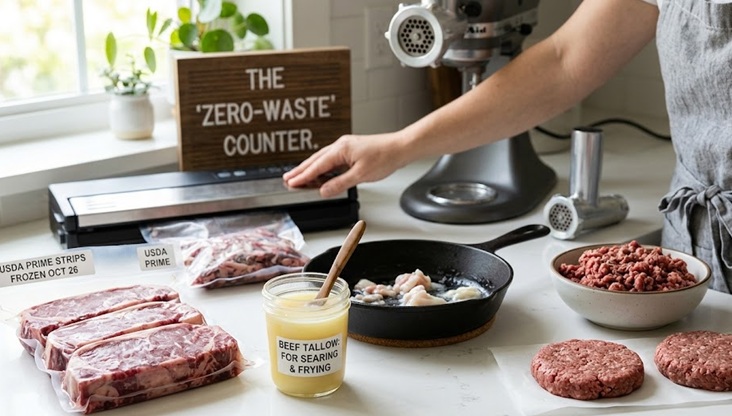
To truly maximize your investment, adopt a “zero-waste” approach to your trimmings:
-
Beef Tallow: Render the white fat scraps down into tallow. It is an incredible high-smoke-point cooking fat for searing steaks or frying potatoes.
-
Ground Beef: Use the smaller meat trimmings to create your own high-end burger blend.
-
Storage: Since you are buying in bulk, vacuum-sealing and freezing your steaks allows you to maintain a “steakhouse” inventory in your own home for months.
By spending twenty minutes at the kitchen counter, you can transform an expensive grocery habit into a sustainable, high-quality hobby that pays for itself.
Recommended For You