Food Lion Large White Eggs – 18 ct cost $2.49, but the low price does not make counter storage worthwhile: these washed supermarket eggs belong in the refrigerator, where they can stay fresh for three to five weeks.
What you are actually bringing home
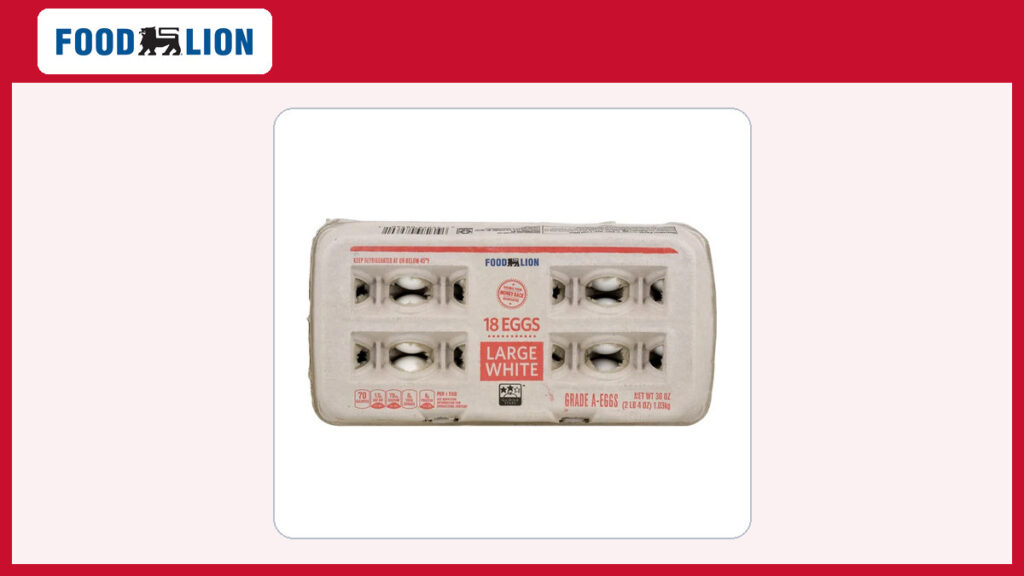
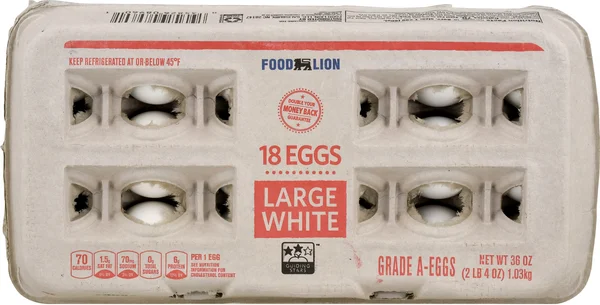
Food Lion Large White Eggs – 18 ct are Grade A large white shell eggs sold under Food Lion’s private label. The 1.5-dozen size costs $2.49 and is an everyday item in the refrigerated Dairy & Eggs section. Each egg has 70 calories, 6 grams of protein, and 185 milligrams of cholesterol; the product is also Guiding Stars rated.
The important detail for storage is not the shell color or store brand. These are standard U.S. supermarket eggs that have been washed and sanitized under FDA rules. Washing removes the shell’s natural protective bloom, so the eggs must remain refrigerated after purchase. Food Lion also offers Cage Free Large White, Extra Large White, and Jumbo White versions, while brown options are available through Nature’s Promise, but a different size or shell color does not change the central advice for washed supermarket eggs.
| Price | $2.49 |
| Size | 1.5 doz |
| Servings | 12-30 (1 egg per serving) |
| Price per serving | $0.10-$0.20 (approx., based on real prices found) |
| Where to find it | Dairy & Eggs (refrigerated section) |
| Availability | Everyday |
Why the refrigerator wins, decisively
The right place for these eggs is their original carton on a middle or lower refrigerator shelf at 40°F or below. That setup protects them from temperature swings, slows bacterial growth, and gives them the longest useful life: three to five weeks from purchase under USDA FoodKeeper guidance. Keeping them in the carton also makes this routine simple—bring them home, place the whole pack on a stable shelf, and leave it there until needed.
The refrigerator door is a poor compromise. Its temperature changes whenever the door opens, while the interior shelves stay more consistent. I would choose the middle or lower shelf even if a refrigerator includes a convenient-looking egg area in the door. For a staple that may remain in the refrigerator for several weeks, steady temperature matters more than saving a few seconds.
This is also why seeing eggs unrefrigerated in another setting should not change your home routine. Supermarkets may sometimes use controlled temperatures, but home conditions are less predictable. Food Lion places this product in its refrigerated section, and home refrigeration remains the safe, definitive choice.
Reliable, affordable—and intentionally ordinary
What earns these eggs a regular place in the cart is dependable everyday usefulness at a private-label price. They provide 6 grams of protein for 70 calories per egg, and the 18-count size is practical when eggs are a recurring part of the household routine. Food Lion Milk makes an easy breakfast pairing, but the eggs do not require any special companion purchase to justify the value.
The honest limitation is that there is no verified claim of a distinctive flavor advantage over premium brands. These are conventional store-brand eggs, not a specialty product built around a unique taste. Buy them because they are a reliable, affordable staple—not because the Food Lion label promises a dramatic flavor upgrade.
There is another tradeoff for anyone accustomed to unwashed farm eggs: these cannot be treated the same way. Their protective bloom has been removed during washing, so the refrigerator requirement is part of the product, not an optional precaution.
The best preparation starts with cold storage
For this particular question, the winning preparation method is refrigeration: keep the eggs in their original carton on a middle or lower shelf at 40°F or below. That method gives you the best combination of safety, consistent temperature, and freshness lasting three to five weeks. No cooking method, time, or temperature was provided for comparison, so the defensible recommendation here is about safe handling rather than inventing a recipe.
Counter storage falls short. If these eggs are out in a cool, stable spot below 70°F, the limit is two hours—not several days and certainly not the one-to-two-week room-temperature window sometimes associated with egg storage. For washed U.S. eggs, room temperature raises the risk of spoilage and bacterial growth, including salmonella, while sharply shortening their potential shelf life.
A brief spell on the counter while breakfast is being made is fine as long as it stays under two hours. After that, the safe answer is not to extend the limit based on how the shells look or feel. Keep the cold chain simple and return unused eggs promptly to the refrigerator.
Upgrades that are actually supported
There is no verified storage hack that improves on the original carton and a stable refrigerator shelf. Moving the eggs to the door for convenience is a downgrade, and leaving them out to reach room temperature creates a clock you then have to monitor. The useful upgrade is organizational: give the carton a dependable middle- or lower-shelf spot where it will remain at 40°F or below.
For serving, Food Lion Butter is a natural item to grab for cooking eggs, while bread or English muffins turn them into a straightforward breakfast combination. Beyond those basic pairings, there are no verified ingredients or preparation hacks here that justify pretending one elaborate treatment is definitive.
The value math—and the catch
At $2.49 for 18 eggs, the arithmetic works out to about 13.8 cents per egg. That lands comfortably inside the supplied estimate of roughly $0.10 to $0.20 per serving when one egg counts as a serving. Six grams of protein for around fourteen cents makes this an economical everyday staple.
For comparison, Eggland’s Best is roughly $3.79 to $4.99 for 12 eggs, or about 31.6 to 41.6 cents per egg. On that math, the name-brand option costs approximately 2.3 to 3 times as much per egg. Food Lion’s eggs are also cheaper than restaurant eggs, so the store brand wins the straightforward value contest even without a special flavor claim.
The catch is mainly about priorities. Skip this version if you specifically want an egg marketed around premium flavor, if you require cage-free eggs and have selected the standard variant, or if you want eggs suitable for extended counter storage. Food Lion does carry a cage-free large white option, but these washed supermarket eggs still require refrigeration. For shoppers who want reliable Grade A eggs at a low unit cost and have proper refrigerator space, the standard 18-count version is worth buying.
Get it here: Food Lion Large White Eggs – 18 ct – $2.49 at the store · checked 2026-10-24.
Quick Questions
Should you store Food Lion eggs on the counter?
No. These are washed supermarket eggs, so refrigerate them after purchase for safety and freshness; counter time should never exceed two hours.
How long do Food Lion eggs last in the fridge?
They can last three to five weeks from purchase when kept refrigerated at 40°F or below.
Can Food Lion eggs be left out?
Only briefly—under two hours. Washing removes the protective bloom, making extended room-temperature storage a bacterial-growth risk.
Is it safe to store eggs in the fridge door?
Use a middle or lower shelf instead. The refrigerator door experiences temperature fluctuations, while an interior shelf provides the stable cold conditions these eggs need.
Food Lion Large White Eggs – 18 ct are a strong value at $2.49, but they are not counter eggs. Keep the original carton on a middle or lower refrigerator shelf, and you get the safest handling, the longest freshness, and the best return on that low price.